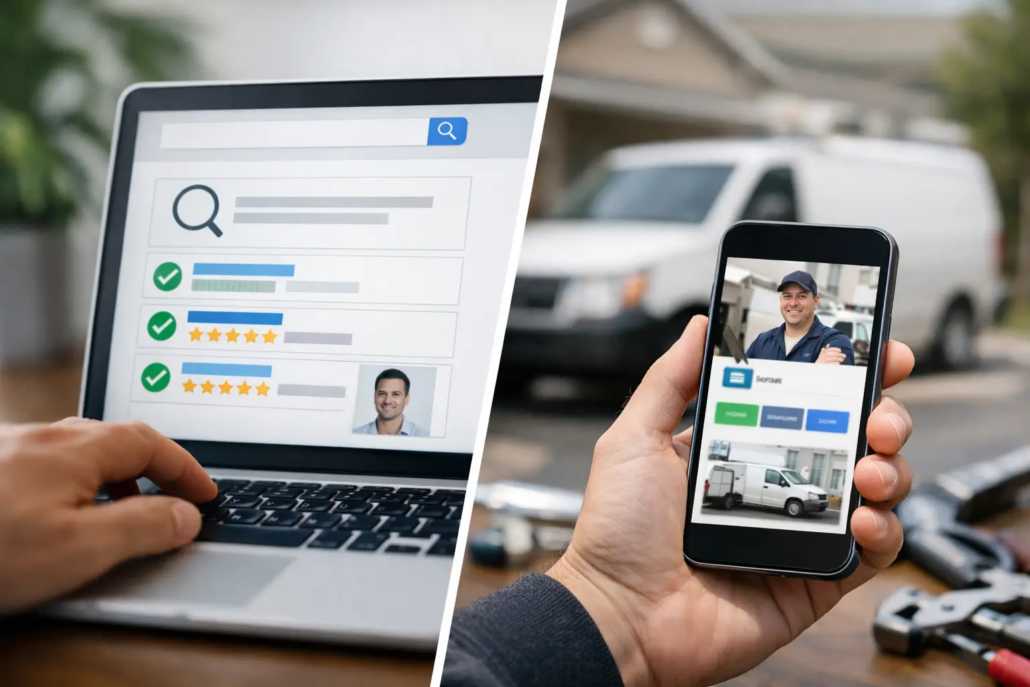
Google Screened vs Local Services Ads
A law firm can spend months improving rankings and still lose the click to a competitor sitting above the map pack with a Google badge and a call button. That is why the google screened vs local services question matters more than most attorneys realize. If your firm is competing in a crowded metro, the difference is not academic. It affects trust, visibility, lead quality, and how fast a prospect contacts your office.
For law firms, these terms are connected, but they are not interchangeable. Local Services Ads is the ad platform. Google Screened is the badge that appears on eligible professional service providers, including many attorneys, after Google verifies certain business and licensing details. Put simply, your firm can run within the Local Services Ads environment, and the Google Screened badge is the trust signal attached to qualifying legal advertisers.
Google Screened vs Local Services: What is the real difference?
Local Services Ads, often shortened to LSA, is Google’s pay-per-lead advertising product built for local service businesses. It appears at the very top of search results in many local-intent searches, often above traditional paid ads and organic listings. A prospect can call, message, or review your firm’s profile without visiting your website first.
Google Screened is not a separate ad platform. It is a verification status and badge shown within Local Services Ads for eligible professional categories. For attorneys, that badge signals that Google has reviewed parts of the business profile, including licensure and background-related checks where applicable. In a legal market where trust drives conversion, that badge can carry real weight.
This is where many firms get confused. They ask whether they should choose Google Screened or Local Services. In practice, the better question is whether your firm should invest in Local Services Ads and qualify for Google Screened within that system. If you are an attorney, the badge is part of the opportunity, not an alternative to it.
Why this matters for law firms specifically
Legal search is not casual browsing. A person searching for a divorce lawyer, criminal defense attorney, or personal injury firm usually wants help now. They are comparing reputations quickly, often on a phone, and they are making judgments in seconds.
That makes high-visibility trust markers extremely valuable. A traditional search ad can get attention. A strong organic ranking can build authority. But a Local Services placement with a Google Screened badge, review count, practice area relevance, and a direct call option can shorten the path from search to signed consultation.
There is a trade-off, though. LSAs do not give you the same level of messaging control as a dedicated landing page or a well-built legal website. You are operating inside Google’s format. That means firms need to think beyond simple lead volume and look at screening, intake quality, practice-area fit, and follow-up speed.
How Local Services Ads actually work
With Local Services Ads, your firm creates a profile that includes practice areas, service locations, business hours, reviews, and verification details. Google then matches your listing to relevant local searches. Instead of paying per click, you typically pay per lead event, such as a phone call or message.
That pricing model is attractive to attorneys who are tired of paying for irrelevant traffic. But pay-per-lead does not automatically mean efficient. Some markets produce strong case inquiries. Others generate mixed quality, especially if the profile is broad, intake is weak, or targeting is too loose.
The firms that do best with LSAs usually treat them as an active channel, not a set-it-and-forget-it listing. They answer fast, dispute invalid leads when appropriate, tighten geographic targeting, refine budgets, and align the ad profile with actual revenue-driving case types.
What the Google Screened badge does for trust
The Google Screened badge helps reduce hesitation. For a prospect who has never heard of your firm, it creates a fast shorthand for legitimacy. That matters in legal advertising because people are not just choosing a provider. They are choosing someone to handle a crisis, a claim, a family issue, or a criminal charge.
It also creates visual separation from firms that are not participating or have not completed verification. In competitive local markets, that small trust edge can improve response rates. It will not fix a weak intake process or poor reviews, but it can increase the number of prospects willing to make first contact.
Law firms should keep one point in mind: the badge is not a substitute for reputation. If your review profile is thin or your intake team is slow, the badge alone will not carry the campaign. It works best when paired with strong social proof, clear practice area alignment, and disciplined follow-up.
Google Screened vs Local Services for lead quality
When attorneys compare google screened vs local services, they are usually really asking about lead quality. They want to know whether these leads are better than PPC, better than SEO, or worth the cost.
The honest answer is that it depends on the market, the practice area, and how your firm handles intake. LSAs can produce excellent high-intent leads because they sit at the top of the page and connect directly to local prospects. They can also produce uneven results if your profile attracts the wrong matters or if your staff cannot convert inquiries quickly.
For example, a personal injury firm in a large city may see strong volume but also heavy competition and higher costs. A family law practice in a suburban region may see lower volume but better conversation quality. A criminal defense firm may benefit from after-hours responsiveness more than almost any profile tweak.
This is why serious legal marketing strategy should never rely on one channel. Local Services Ads can be a powerful acquisition source, but they are strongest when supported by organic SEO, map visibility, review generation, and conversion-focused website performance.
Where LSAs fit in a modern legal visibility strategy
A lot of agencies treat LSAs as a shortcut. They are not. They are one layer of local search dominance.
If your law firm wants durable growth, you need multiple positions on the search results page. You want Local Services visibility, strong map pack presence, organic rankings, branded authority, and increasingly, AI-ready content that helps your firm surface in evolving search experiences. That is where firms gain leverage. You do not win by appearing once. You win by appearing everywhere that matters when a client is ready to hire.
For attorneys, AI optimization is becoming part of that equation. Search behavior is shifting. Google is surfacing more synthesized results, more entity-based relevance signals, and more trust-driven business profiles. Firms that structure their online presence clearly, maintain consistent authority signals, and build strong review ecosystems are in a better position across both traditional search and AI-influenced discovery.
That is one reason specialized legal marketing matters. A generic agency may know how to launch ads. A legal-focused team understands intake economics, case value, bar compliance sensitivity, practice-area targeting, and how Local Services should work alongside legal SEO, Google Business Profile optimization, and reputation strategy.
When Google Screened and Local Services are worth it
For most local and regional law firms, LSAs are worth serious consideration if you serve a defined geography, depend on inbound leads, and can respond quickly. They are especially useful when your firm wants faster visibility than SEO alone can provide.
They may be less effective if your practice is highly niche, your service area is too broad to manage efficiently, or your intake process is inconsistent. Firms that do not answer calls quickly often waste money here. The platform rewards responsiveness, profile strength, and operational discipline.
The strongest results usually come from firms that know their best case types and are willing to build around them. If your most profitable work comes from a narrow set of matters, your Local Services setup should reflect that. Broad targeting may inflate lead counts while lowering actual signed-case performance.
The real decision for attorneys
The real choice is not google screened vs local services as if they are opposing options. The real decision is whether your law firm is ready to use Local Services Ads the right way and qualify for Google Screened as part of that process.
That means treating your profile like a revenue asset. Reviews need attention. Intake needs speed. Practice areas need focus. Your website, map presence, and AI optimization should reinforce the same authority signals Google sees in your ad profile. When those pieces line up, Local Services can become more than another lead source. It can become a strategic edge.
For firms that want stronger visibility in legal search, the smartest move is rarely to pick one channel and hope. It is to build a local search presence that makes your firm easier to find, easier to trust, and easier to contact the moment a prospect is ready to hire.